In the heart of Valencia, the thick walls of the Valencia Cathedral They house not only relics and secrets, but also a deep devotion and traditions that intertwine with an unparalleled cultural and architectural value. Alongside it, stands the emblematic Gothic tower The Miguelete, a symbol of the city.
Today we invite you on a journey through the history, architecture and beliefs that come to life in the Cathedral, El Miguelete and the Holy Chalice.


The Cathedral of Valencia or Cathedral of the Holy Chalice
This imposing structure is not only a place of worship; it is a time capsule that showcases the layers of Valencia’s history. Originally a temple dedicated to Jupiter in Roman times, the site evolved over the centuries: first into a Christian church in the 6th century, then transformed into a mosque under Muslim rule.
With the conquest of Valencia by King Jaime I in 1238, The aljama mosque gave way to the current Cathedral of Valencia. Curiously, the construction of the Cathedral, as we know it today, did not begin until 24 years after the conquest, spanning over four centuries.
Its official name, Cathedral Basilica Metropolitana of the Assumption of Our Lady Santa María de Valencia, reflects its meaning and relevance. Today, the Cathedral has a cross-shaped plan with a central nave 22 meters high and side aisles that reach almost 16 meters.
In 1459, the Cathedral expanded to include the majestic bell tower The Miguelete and the chapel that houses it Holy Chalice, creating an even more grandiose complex.
The Fascinating Exterior of the Cathedral of Valencia
The Cathedral of Valencia, an architectural collage over time, harmoniously blends elements of the Romanesque, Baroque, and Gothic styles, with the latter being the most prominent. We will explore some of its highlights:
The Main Gate or Iron Gate

Known as the most recent entrance of the Cathedral, the Main Entrance it was built between 1703 and 1741.
Of French Gothic style, it was built between the 13th and 14th centuries and, although it is unknown who its author was, it is known that by 1354 it would have been completed, and it can be attributed to Nicolás Ancona, master of the Cathedral at the moment.
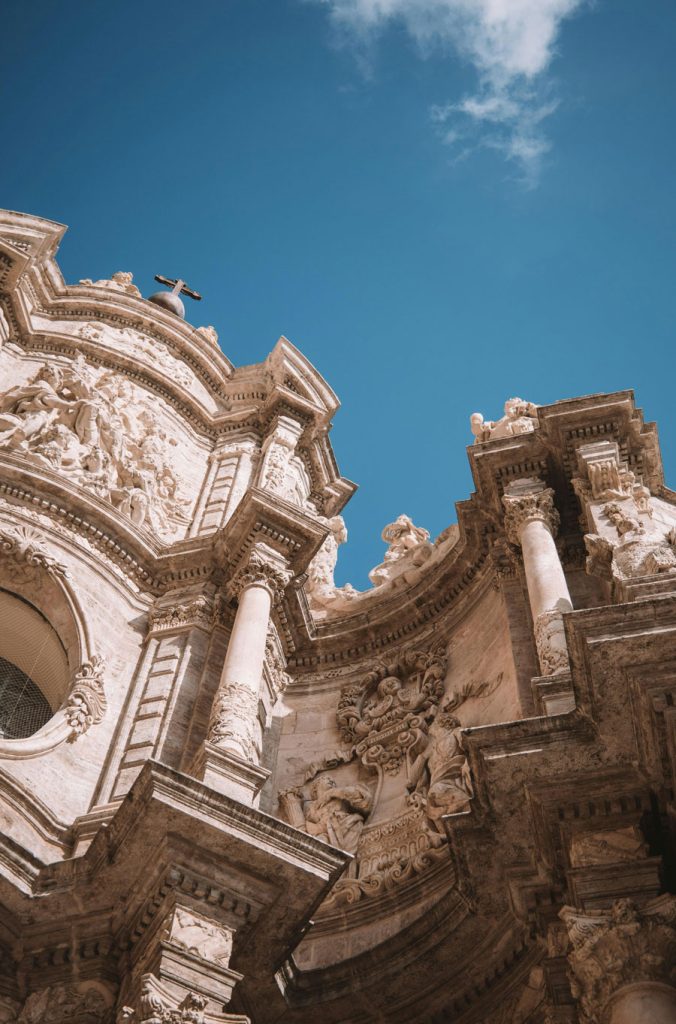
This portal, a a masterpiece of the Baroque, It is set within an impressive three-level facade:
- In the first body, Just above the portal, elegant figures of angels in honor of the Virgin can be seen. On each side of the door are niches with life-size statues of St. Thomas of Villanueva and St. Peter Pascual.
- The second body It is adorned with a striking oval rose window, accompanied by crystal chandeliers and several sculptures.
- In the third body, Two large stone angels worship a cross located on a bronze sphere, forming a spectacular composition.
This door is also known as the Iron Gate, Because of the iron bars that guard the entrance.
Almonia Gate or Palace Gate

The Puerta del Palau, named so because of its proximity to the Bishop's Palace, is a Romanesque entrance built in the 13th century. It is the oldest entrance of the cathedral, being of Romanesque style and differing from the rest of the architectural ensemble predominantly of Gothic style. It has twelve columns, six on each side, whose capitals feature sculpted figures representing Biblical scenes.

Above the archways of the portal, there is a series of canecillos with 14 human heads carved in stone, These heads are surrounded by legends: one account depicts the seven marriages that brought 300 maidens to Valencia to marry the city's first Christians, while other narratives suggest that they are the benefactors of the construction of the portal. These heads, shrouded in mystery, continue to welcome visitors to the cathedral.
Every element of the exterior of the Cathedral of Valencia is not only a testament to the evolution of architecture, but also a reflection of the city’s rich history and legends.
Gothic gate or «of the apostles»

The Gate of the Apostles The Cathedral of Valencia owes its name to Twelve carved apostles on its front page. Located in front of the Plaza de la Virgen, this door is characterized by its four pointed arches that unite harmoniously, forming a triple archivol. In its intercolumni, forty-eight reliefs can be admired depicting virgins, angels and blessed, creating a visual spectacle of faith and art.
This work, a clear example of French Gothic style, It was built between the 13th and 14th centuries. Although the author of the door remains a mystery, it is believed that for the year 1354 It was already completed, possibly under the direction of Nicolás Ancona, the cathedral’s master builder at the time.

The Water Tribunal
A historical and cultural curiosity takes place at the foot of this door: every Thursday at 12 noon, the Water Tribunal, The Council of Irrigation, an ancient institution that decides on the use of water in the Valencian countryside. This unique tradition attracts both locals and visitors interested in the history and culture of Valencia.
El Miguelete: A Historical and Cultural Symbol in Valencia

Right next to the main entrance of the Valencia Cathedral The impressive one rises Torre El Miguelete (or Micalet), whose construction extended from 1381 to 1425. This tower is much more than just a monument; it is a symbol of Valencian pride and identity.
Over the centuries, El Miguelete has been the preferred venue for announcing and celebrating significant events in Valencia, including canonizations, royal coronations, festivals of the patron saints, and military victories.
The name “El Miguelete” comes from a special blessing performed in honor of San Miguel on September 29, 1418, coinciding with the saint’s date. The tower, with its more than 50 meters of height and octagonal shape, is a living testimony to Valencian history.
The Secrets of El Miguelete
The Miguelete is composed of four levels, Its upper part is the only one adorned with decorative elements such as moldings and pointed arches. The structure of the tower, built with brickwork, reflects the passage of time in its color and texture.
Climbing El Miguelete is an experience in itself. You’ll find a spiral staircase with 207 steps that takes you through different levels, each with its own story:
- The First Level: Formerly a refuge for those seeking asylum from the law.
- The Second Level: A small room where the sacristans lived.
- The Third Level: The Bell Room, home to 11 historical bells, each dedicated to a saint. Among them, the following stand out:
- La María, the largest.
- La Catalina, famous for its resistance.
- La Bárbara, The only one with a computer-controlled engine.
A curious fact is that, in the 16th century, Queen Doña Juana, known as “La Loca”, enjoyed the sound of all the bells playing simultaneously, an experience both fascinating and overwhelming.
Nowadays, the complete ringing of the bells only happens once a year, on Corpus Christi Day at 12:00.
The Terrace of El Miguelete
When you reach the top, you will find a terrace adorned in Gothic style. Here, you will find a templete that houses:
- The Micalet, a bell that marks the hours of the day.
- The Quart Bell, which announces the quarters of an hour during the day and the means during the night.
From here, you will enjoy a spectacular panoramic view of Valencia, a view that has captivated both locals and visitors from all over the world.

Exploring the Interior of the Cathedral of Valencia

As you enter the Valencia Cathedral, The first thing that will catch your attention will be the three main ships. As you approach the Altar Mayor, You will be fascinated by the lush Baroque decoration, a display of contrasting colors, gold and marble, complemented by images of angels that adorn the space.
Then head to Cimborrio, And when you look up, you’ll discover an impressive hexagonal prism that rises more than 40 meters, adorned with translucent alabaster windows that bathe the interior in natural light.

Throughout the nave and in the choir (behind the High Altar), they are distributed 24 chapels, Each one has its own unique history and distinctive art. Among them are:
- Chapel of San Francisco de BorjaHere you will find a painting by Mariano Salvador Maella depicting San Francisco de Borja before the corpse of his wife, Empress Isabel, a crucial moment in his spiritual calling.
- Chapel of the ResurrectionIt houses one of the cathedral's most revered relics, the incorruptible arm of Saint Vincent the Martyr, tortured during the Roman Empire.
The Holy Chalice: A Relic of Inestimable Value

Inside the Cathedral, to the right of the main entrance, there is the Chapel of the Holy Chalice. Within this chapel, protected by crystals, is the famous relic that, according to tradition, Jesus used at the Last Supper. This agate cup, 3 mm thick, dates back to the 1st century AD according to archaeological research.
The story of this chalice is fascinating. Historical documents suggest that it was brought to Rome by Saint Peter and guarded by the Popes throughout the centuries. In the third century, it was moved to Valencia for its protection.
Those who have examined the chalice describe it as almost magical effect: In the light, it seems to burn like a torch, a phenomenon that has captivated believers and curious alike. The presence of this cup in Valencia adds a halo of mystery and devotion to the already impressive cathedral.
Discovering the Underground Secrets of the Cathedral of Valencia
Beneath the surface of the Valencia Cathedral, a few three meters deep, Hidden within is a fascinating world of archaeological remains dating back to the Roman era until the medieval period. Here you can find everything from 3rd-century round-toed pavements, remains of Roman houses with drainage systems from the 2nd century, to a well of the 18th century and the old one cemetery parochial church of San Pedro from the 13th century. In fact, some remains humans They rest in this historic place. This window into the past can be explored in the tenth room of the Cathedral’s underground, accessible through the Church Museum.


The Song of the Sibyl: A Living Tradition
One of the oldest and most evocative traditions of Valencia is “The singing of the Sibyl in the Cathedral of Valencia”, This ceremony, which takes place a few days before Christmas, is attended by musicians, choirs and soloists who perform medieval chants on instruments that are replicas of those seen in the frescoes of the High Altar.
The Canto de la Sibila is a deeply religious musical and theatrical performance that heralds the birth of Jesus. This tradition, established by King Jaime I in the 13th century, remains a moving and revered event today.