
The Plaza de la Virgen It is not only the epicenter of Valencia, but also the link between its foundation and its vibrant present. Here, among buildings that are witnesses to history, traditions and celebrations in honor of the revered Geperudeta unfold.
Nestled in the old town, next to the imposing Cathedral and the iconic Miguelete, the square stands as an obligatory enclave for those visiting the city. It offers magnificent views and the opportunity to immerse yourself in its atmosphere while relaxing on the terraces that adorn it.
We invite you to explore the Plaza de la Virgen, a place where every step is a meeting with history, culture and the pulse of Valencia.
The Enchanting Plaza de la Virgen: Cradle and Mirror of Valencia
About the footprints of a Roman forum the lifting up Plaza de la Virgen, the jewel of Valencia, a scene that has witnessed 2000 years of history, From daily meetings to events that have shaped the course of the city.
Considered the most beautiful square, this is where Valencia took root, a fact that a commemorative plaque does not forget. Today, it is a vibrant core of Valencian life, with spacious terraces, cafes, and bars that invite you to enjoy local flavors such as horchata and other regional delicacies.
Exploring Plaza de la Virgen in Valencia
The Plaza de la Virgen offers a space completely pedestrianized and almost rectangular which stands out for being surrounded by historical buildings.
The Turia Fountain or Neptune's Fountain

The Fountain of the Turia It is the centerpiece of the square, an artistic work from 1976 created by Manuel Silvestre Montesino as a tribute to the river that gives life to Valencia. When you look at it, the first thing that catches your attention is the male bronze statue, which lies in the center, symbolizing the vigor of the Turia River and alluding to the God Neptune. This emblem holds the horn of abundance, an iconic symbol of the city.
Surrounding this central figure are 8 female statues, representations of the aqueducts that fed the river, They are different in their pose and how they hold their pitchers, symbolizing the diversity of the waters that flow through Valencia.
For example, the aqueduct Mislata He shows the pitcher at his feet, the well of Tormos holds the bucket on his right shoulder, while the gutter of Favara He shows the jug under his left foot.
The Basilica of the Virgin of the Despised: A Sanctuary in the Heart of Valencia
The Basilica of the Virgin of the Despised It is the shrine where the image of the Virgin of the Innocents Martyrs and Despised, patroness of Valencia, is venerated, and it is an essential visit in the Plaza de la Virgen.
Built between 1652 and 1667 under the direction of Architect Diego Martinez Ponce, The basilica is a fusion of classicism with Baroque decorations, crowned by an impressive elliptical dome.
Inside the basilica, you can admire several chapels and a dome 19 meters wide, Magnificently adorned with paintings by the artist Antonio Palomino.
In the Virgin's dressing room You will discover the beloved image of the Geperudeta, an affectionate nickname that the Valencians give to their patroness.
A Heavenly Touch in the Basilica of the Virgin of the Despised
Wrapped in a veil of mystery and divinity, the Basilica of the Virgin of the Despised It houses an image of the Virgin that, according to legend, was carved by angelic hands. This belief stems from the extraordinary compassion and beauty emanating from the sculpture; attributes that transcend human skill.
The story goes that in 1409, At the same time as the foundation of a hospice for the destitute, four pilgrims presented themselves offering to sculpt the image of the Virgin. After days of confinement in «La Ermita» and without trace of their presence, the door was torn down, revealing not the artisans but the sublime figure of the Virgin., feeding the belief in their heavenly origin.
To this day, it is believed that no sculptor has been able to replicate its majesty, and those who have tried to do so testify to a supernatural aura in its presence.
Admission to this sanctuary is free, Open to the public every day at set times, inviting everyone to contemplate this celestial work of art.
The Gate of the Apostles of the Cathedral of Valencia
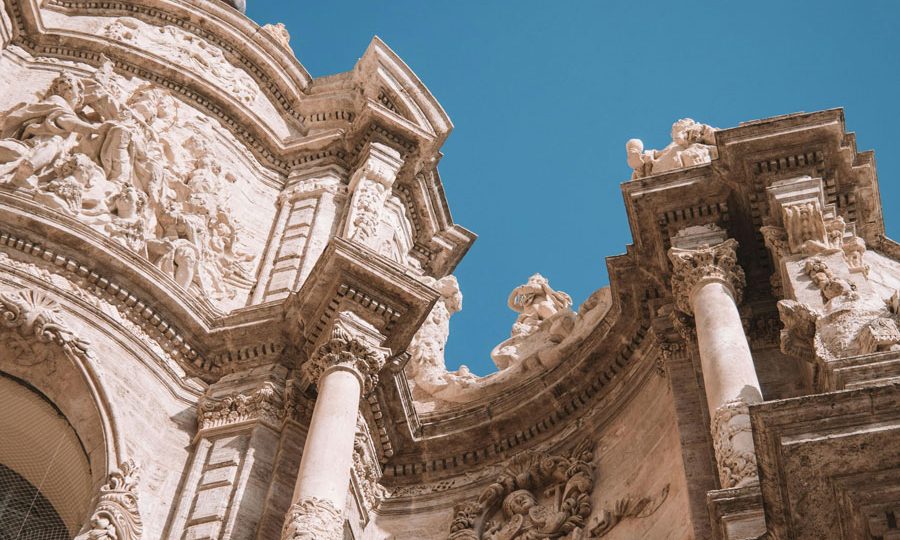
The Gate of the Apostles The Cathedral of Valencia is an essential landmark on Plaza de la Virgen. This portal is one of the three main entrances to the historic cathedral and stands out for its magnificent Gothic architecture.
Built between the 13th and 14th centuries, The door is guarded by twelve statues of apostles carved in stone, six on each side, which confer it an unmistakable majesty and exceptional artistic value.
Emblematic Cultural Events in the Plaza de la Virgen
The Plaza de la Virgen is not only famous for its architecture and history, but also for being the setting for important cultural and traditional events:
The Water Tribunal:
Declared a World Heritage Site and considered the oldest court of justice in Europe, the Tribunal de las Aguas is a tradition that dates back to the Muslim era in Valencia. This Tribunal was responsible for mediate disputes over the use and distribution of water from the aqueducts of the Turia River.
Preserved throughout the centuries, this judicial institution still exists. He exercises his authority over the irrigation systems of the region every Thursday at noon in the Cathedral's Gate of the Apostles, offering an oral and public trial. It is a unique opportunity to observe a piece of living history and a fundamental aspect of Valencian culture.
The Emotive Floral Offering to the Virgin of the Despised
Each March 17th and 18th, In the Plaza de la Virgen, one of the most emotional traditions takes place: the offering of flowers to the Virgin of the Despised. The carnival groups parade in a show of gratitude, presenting bouquets of roses to the patroness of the city.
An impressive representation of the Virgin, which rises to more than 15 meters high, He waits in the square. His cloak, a wooden structure, is adorned with the lilies of the offerings, creating a spectacular floral tapestry that combines the purity of the white flowers with artistic touches in red and pink.
This event captures the essence of Valencian devotion, offering a visual and olfactory spectacle that captivates both locals and visitors.
The Rock Parade in Corpus Christi
During the celebration of Corpus Christi, the Rocks, Historical and majestic triumphal carriages parade through the streets of Valencia. These carriages, carrying large religious figures, are a tradition that dates back centuries.
On this festival, the Rocas are mobilized through the streets: some are pushed manually and others are pulled by horses adorned with striking harnesses. This route prefigures the procession that will follow later. At the end of their march, the Rocas find their rest in the Plaza de la Virgen, In front of the Basilica of the Virgin of the Despised, thus completing another chapter of this solemn ritual.
The Dance of the Moma
The Dance of the Moma is part of the popular-folkloric heritage of Valencian identity, carried out in the festivities of Corpus Christi, It takes place in the Plaza de la Virgen. It is a symbolic dance to the rhythm of a dulzaina and a tambor, In it, the eternal battle of life is interpreted, the struggle between virtue and the capital sins.
The Momos represent the cardinal sins; they dress in red and black outfits and dance around the Momom. While the Momom represents virtue or Grace, so she dances all in white. The ending is instructive; virtue, as always, defeats all sins.
Access to the Plaza de la Virgen: Your Gateway to Valencia's History
Located in the heart of the old town, the Plaza de la Virgen It is easily accessible from Navellos Street to the north, from the Calle del Cavallers to the west, and from Calle del Micalet to the south.
To get to this emblematic place, you have several transportation options: take the Metrovalencia Line 1, or if you prefer the train, the lines C2 or C3 They will take you to your destination. There are also several bus lines that pass through the area, including the Lines 160, 26, 27, 60 and C1. And for maximum convenience, you can request a taxi using a mobile app.
How to get to Plaza de la Virgen from Botánico Coworking
To visit the Plaza de la Virgen from Botánico Coworking, Located in the heart of Valencia, You have several options:
- On footEnjoy a 20-minute walk that will allow you to appreciate the beauty of the city. Head south along Calle del Turia, turn right onto Calle de Guillem de Castro and then left onto Calle de Caballeros until you reach the plaza.
- By busYou can take several bus lines that take you to Plaza de la Virgen. The stop closest to the coworking space is on Gran Vía Fernando el Católico, just a few minutes' walk away.
- By bicycleValencia has bike lanes and a bike rental service that will allow you to reach the Plaza de la Virgen while enjoying the Mediterranean climate.
- By taxi or rental vehicleFor a more comfortable and direct journey, you can opt for a taxi or a rental car. Use your preferred mobility app to request the service.
Whatever your choice, getting from Botánico Coworking to Plaza de la Virgen is a straightforward journey that immerses you in the vibrant atmosphere of Valencia.
With these instructions, Plaza de la Virgen awaits you to explore its rich history and culture. Valencia invites you to create unforgettable memories!